
 Logistics
 Industry

 +31 (0)172 769 123
 info@one2id.com


A guide to label materials
Read our expert tips for printing your own barcode labels
Our consultants answer some of the most frequently asked questions about label materials and in-house label printing. Please feel free to contact us for personalised advice. We are here to help.
Which label material is suitable for my application?
Label materials come in all shapes and sizes. To choose a suitable material for your application, it is important to first answer a number of key questions to make certain the label material meets your exact requirements.
- For what application will you be using the labels?
- What are the required label dimensions?
- What is the annual label volume?
- What is the key performance requirement? For example, resistance to high temperatures, weatherproof and waterproof properties, chemical resistance, resistance to oils and grease, UV resistance, (extremely) low temperatures, etc.
- What is the desired lifespan of the labels?
- Does the print need to remain scratch-resistant over time?
- Are there specific industry standards or regulations that the material must comply with, such as REACH or RoHS?
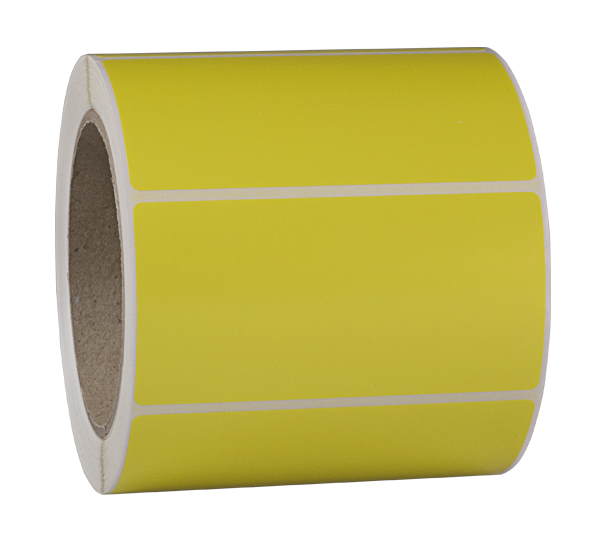
Do you have any questions or would you like tailored advice? Our consultants are here to answer any and all questions about label materials, cleaning protocols and more. You can also request free samples or order installation tools and cleaning products such as squeegees, industrial adhesive removers, and degreasers.
Can I test the label material first?
Yes, you can. We strongly advise testing the label material with our free samples under actual operating conditions before placing an order. This helps you assess whether it meets your specific requirements and any industry-specific standards. A few practical tips from our label experts to achieve the best test results:



What is the correct way to store label materials?
Our label materials are supplied on rolls. Always take the rolls out of the box and, ideally, store them in a dark environment, flat and with the core facing upwards. Storing the rolls on their curved side can cause the adhesive to flow due to gravity and the weight of the roll. This can negatively affect both print performance and the quality of the labels.
The temperature at which the labels are stored also plays a key role. Higher temperatures soften the adhesive, making it more likely to flow. For best results, keep label rolls in a cool place, away from heat and direct sunlight.
What is the shelf life of label materials?
The shelf life of label materials depends on their specific properties. Most label materials can be stored for approximately one year when kept below 27°C and at 50–60% relative humidity.
Label materials with a thick, high-tack but relatively soft adhesive, such as M1008, M1101 and M1321, can show signs of adhesive bleed over time. This can affect how the labels pass through your printer. For these specific materials, we recommend keeping no more than six months’ worth of labels in stock. Please contact us for detailed specifications for the material you need.
Why does the surface need to be clean?
Label application can be labour-intensive and time-consuming, especially when you need to apply several thousand labels. Cleaning the surface, however, typically takes up to three times longer. It is therefore not surprising that this step is often skipped or not done properly. This is generally where problems arise.
Without a properly cleaned surface, we can almost guarantee your labels will need replacing within a few months. Even the strongest, high-performance adhesive will not bond effectively to a dirty, greasy or dusty surface. Compare the process to, for instance, repainting a wooden fence: before applying a new coat of paint, the old layer should first be sanded away and the surface thoroughly cleaned and left free from dust and dirt. By the same token, a proper cleaning process significantly extends the lifespan of your labels.

What is the difference between direct thermal and thermal transfer label printing?
Direct thermal printing

As the name suggests, direct thermal printing uses heat to create text or barcodes directly onto specially coated, thermally sensitive label material, without the need for ink or a printer ribbon. The resulting print is not scratch-resistant, and both the printed information and the label colour will fade over time. Labels printed with direct thermal technology are therefore best suited for temporary applications such as shipping labels, product labels and receipts.
Thermal transfer printing

Thermal transfer printing uses a ribbon to transfer ink onto the label surface. The ink penetrates the label material and produces a highly durable print. You can select different ribbon types (such as wax or resin) for specific materials and applications to optimise performance and durability. Thermal transfer printing is the standard for industrial labelling that requires long-lasting and high-quality identification.
Zelf etiketten printen of professioneel laten printen?
In-house printing
In-house printing
Professional printing company
Professional printing company
Advice

Samples

Brochure
